
Commercial vs. Non-Residential: Are They the Same in Construction?
 Jun, 11 2026
Commercial vs. Non-Residential Construction Comparison
Understanding the distinction between commercial and non-residential construction is vital for permits, zoning, insurance, and building codes.
| Feature | Commercial Construction | Non-Residential Construction |
|---|---|---|
| Primary Purpose | Business operations & revenue generation | Any use except permanent residence |
| Examples | Retail shops, offices, hotels, restaurants | Factories, schools, hospitals, farms, plus commercial buildings |
| Zoning Classification | Often C-1, C-2, etc. (Commercial zones) | Covers C, I (Industrial), M (Mixed), and sometimes P (Public) zones |
| Building Codes | Focused on public safety, accessibility, egress | Varies widely; industrial may focus on structural load/fire resistance |
| Insurance Type | Commercial General Liability, Business Owner Policy | Specialized policies for industrial/institutional risks |
Key Takeaway
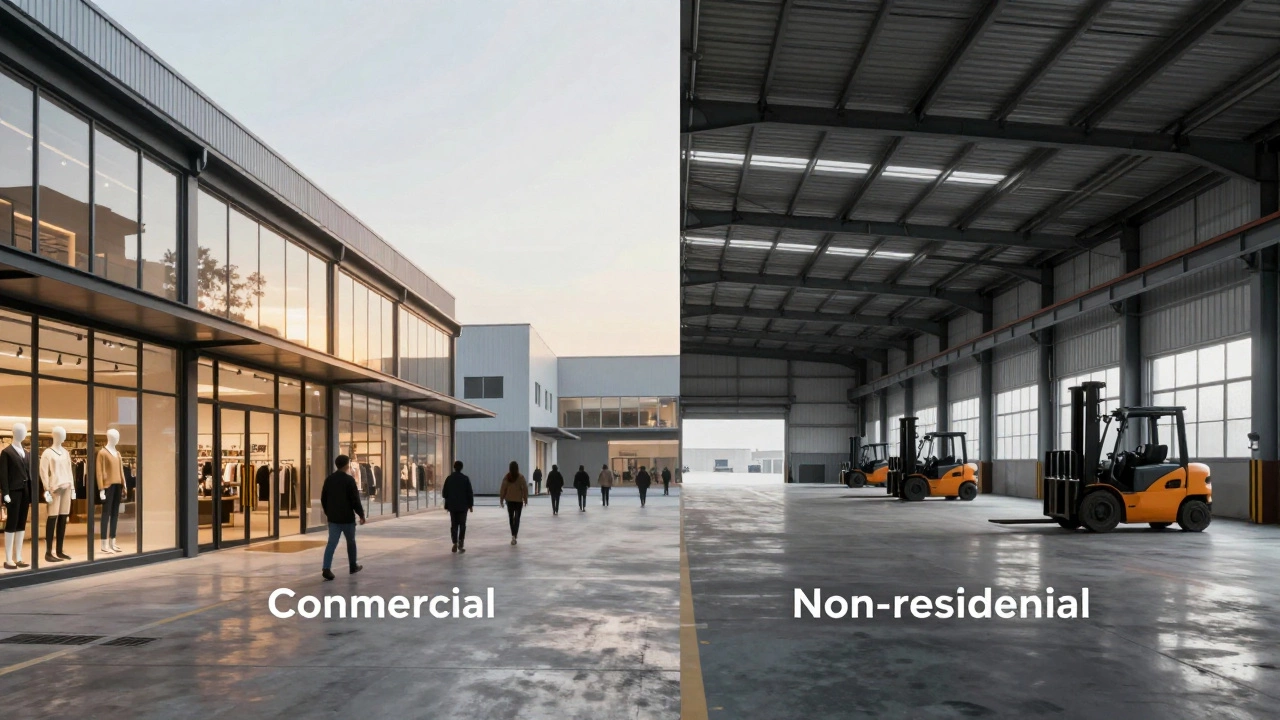
While all commercial buildings are non-residential, not all non-residential buildings are commercial. A public library or a factory is non-residential but does not fit the traditional definition of commercial trade and service.
It’s a question that trips up investors, developers, and even seasoned contractors more often than you’d think. You’re looking at a vacant lot or an old warehouse, and the paperwork uses terms like commercial construction and "non-residential" interchangeably. It feels like they mean the same thing. After all, if it’s not a house, isn’t it just a business building? The short answer is yes, but the long answer involves a maze of legal definitions, insurance policies, and building codes that can make or break your project.
In the world of real estate and development, precision matters. A slight misunderstanding between these two terms can lead to denied permits, voided insurance claims, or unexpected tax liabilities. While they overlap significantly, they are not identical twins. One is a functional category; the other is a legal and regulatory classification. Let’s untangle this knot so you know exactly what you’re dealing with before you pour concrete or sign a contract.
The Core Definition: Function vs. Exclusion
To understand the difference, we have to look at how each term is defined by different authorities. Commercial construction refers specifically to projects designed for business activities. This includes office buildings, retail stores, shopping malls, hotels, and restaurants. The primary goal here is revenue generation through commerce. When you hear "commercial," think of transactions, customers, and employees.
Non-residential construction, on the other hand, is a broader umbrella term. It literally means "not for living." This category includes commercial buildings, yes, but it also encompasses industrial facilities (factories, warehouses), institutional buildings (schools, hospitals, government offices), and agricultural structures. If a building doesn’t have bedrooms, kitchens, and bathrooms intended for permanent human habitation, it falls under non-residential. So, while all commercial buildings are non-residential, not all non-residential buildings are commercial. A public library is non-residential but not commercial in the traditional sense.
| Feature | Commercial Construction | Non-Residential Construction |
|---|---|---|
| Primary Purpose | Business operations & revenue generation | Any use except permanent residence |
| Examples | Retail shops, offices, hotels | Factories, schools, hospitals, farms, plus commercial |
| Zoning Classification | Often C-1, C-2, etc. (Commercial zones) | Covers C, I (Industrial), M (Mixed), and sometimes P (Public) zones |
| Building Codes | Focused on public safety, accessibility, egress | Varies widely; industrial may focus on structural load/fire resistance |
| Insurance Type | Commercial General Liability, Business Owner Policy | Specialized policies for industrial/institutional risks |
Why the Distinction Matters for Permits and Zoning
If you’ve ever dealt with city planning departments, you know that words have power. Local councils and municipal authorities use specific terminology to enforce zoning laws. In many jurisdictions, including cities across New Zealand and Australia, zoning maps distinguish between "Commercial" and "Industrial" or "Institutional" zones. These are all subsets of non-residential land use, but they come with different rules.
For example, a piece of land zoned for light commercial might allow you to build a café or a boutique. However, that same zone might strictly prohibit heavy manufacturing or large-scale warehousing, which would fall under industrial non-residential use. If you assume "non-residential" gives you a free pass to build any type of facility, you could face a stop-work order halfway through construction. Always check the specific zoning code, not just the general residential/non-residential split.
Furthermore, building consents often require detailed statements of compliance. For a commercial project, inspectors will scrutinize fire exits, elevator shafts, and ADA (or local equivalent) accessibility standards because the public has access. For an industrial non-residential site, the focus might shift to hazardous material storage, ventilation systems, and structural integrity for heavy machinery. The risk profile is different, so the regulatory scrutiny changes accordingly.
Construction Standards and Building Codes
The physical act of building differs significantly between these categories. Residential construction relies heavily on wood framing, simpler electrical systems, and standardized plumbing fixtures. Commercial and non-residential projects typically require steel or reinforced concrete frames, complex HVAC systems, and commercial-grade wiring.
Fire safety is a major differentiator. Fire codes for commercial spaces are stringent. Buildings must have sprinkler systems, fire-rated walls, and multiple exit routes. In contrast, some low-risk non-residential structures, like small agricultural sheds or certain industrial storage units, might have less rigorous fire suppression requirements, depending on their occupancy load and contents. However, high-occupancy non-residential buildings like schools or hospitals have even stricter codes than standard retail stores due to the vulnerability of occupants.
Materials also play a role. Commercial interiors need durable flooring, impact-resistant doors, and commercial kitchen equipment. Non-residential industrial spaces might prioritize chemical-resistant coatings and high-load capacity floors. Using residential-grade materials in a commercial setting is a common mistake that leads to rapid wear and tear, failed inspections, and higher maintenance costs down the line.

Financial Implications: Loans, Insurance, and Taxes
Money talks, and lenders listen closely to the distinction between commercial and non-residential properties. Banks classify loans based on the property’s income-generating potential and risk. A Commercial loan for a retail strip mall will have different interest rates, down payment requirements, and amortization periods compared to a loan for an industrial warehouse. Lenders view industrial properties as having different market volatility and tenant retention rates than retail or office spaces.
Insurance is another critical area. Standard homeowner’s insurance covers residential properties. Once you cross into non-residential territory, you need commercial property insurance. But within that, the coverage details vary. A restaurant (commercial) needs coverage for slip-and-fall liability and food spoilage. A factory (industrial non-residential) needs coverage for machinery breakdown and product liability. Mixing up these categories can result in gaps in coverage. If you label your project incorrectly on an application, the insurer might deny a claim after a disaster, arguing misrepresentation.
Taxation also hinges on this classification. Property taxes are assessed differently for commercial versus industrial or institutional non-residential properties. In some regions, historical or cultural non-residential buildings might qualify for tax abatements that standard commercial buildings do not. Understanding the exact classification helps in accurate financial forecasting and avoiding surprise tax bills.
Common Scenarios Where Confusion Arises
Where do people usually get tripped up? Mixed-use developments are the biggest culprit. Imagine a building with apartments on the top three floors and a grocery store on the ground floor. The upper levels are residential; the lower level is commercial. But is the whole building non-residential? No. It’s mixed-use. The construction standards for the entire structure often default to the stricter commercial code because of the public access element, even though part of it is housing.
Another tricky area is accessory dwelling units (ADUs) or home-based businesses. If you run a consulting firm from your house, it’s still legally residential. But if you start hosting clients regularly and parking multiple company vehicles, local ordinances might reclassify parts of your property usage, affecting your insurance and zoning compliance. Similarly, converting a residential garage into a workshop for hire moves it from residential accessory use to commercial non-residential use, triggering new permit requirements.
Short-term rentals like Airbnb also blur the lines. While the structure is residential, its use is commercial. Many cities now have specific regulations for "commercial lodging" that differ from both standard residential leases and hotel operations. Ignoring this nuance can lead to fines or forced closures.
How to Verify Your Project’s Classification
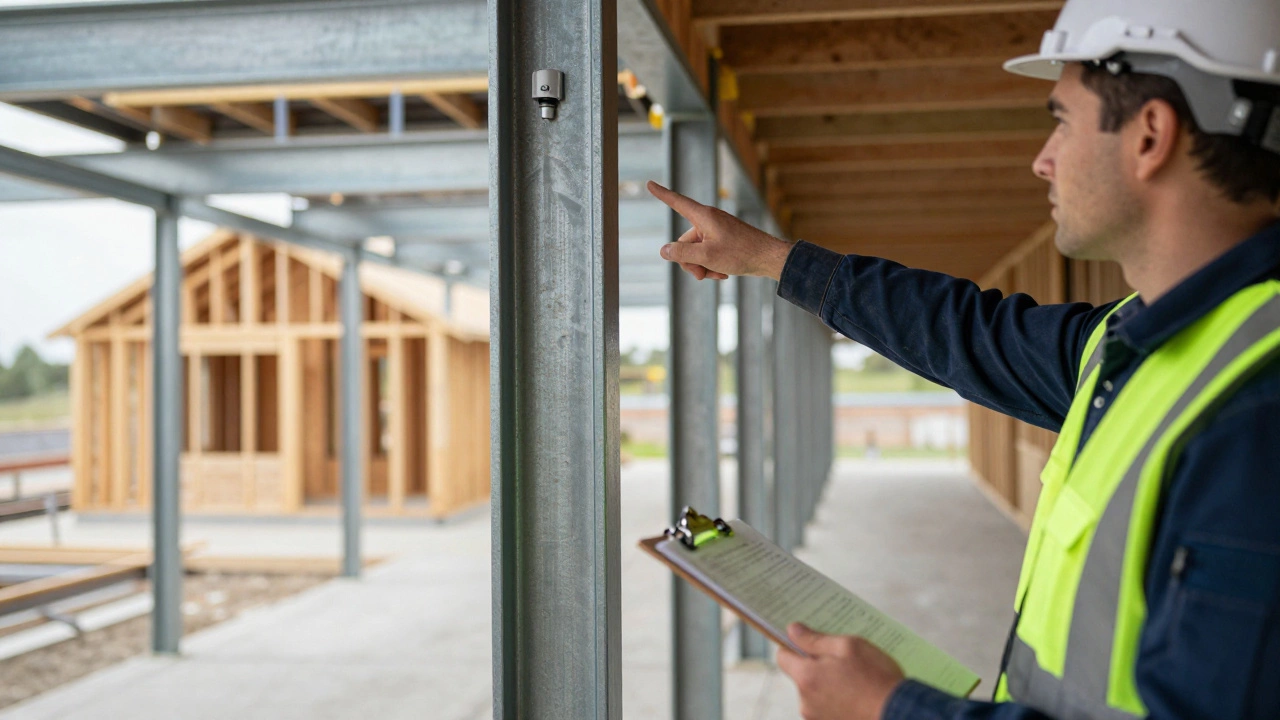
Don’t guess. Verification is simple if you follow these steps:
- Check the Zoning Map: Visit your local council or city planning website. Look up the address or parcel number. The zoning designation (e.g., R-1 for residential, C-1 for commercial, I-1 for light industrial) tells you the allowed uses.
- Read the Building Code: Consult the International Building Code (IBC) or your local adopted code. Chapter 3 defines "Occupancy Classifications." This is the gold standard for determining whether your project is Assembly, Business, Educational, Factory, Institutional, Mercantile, Residential, Storage, Utility, or Agricultural.
- Consult a Professional: Hire a licensed architect or engineer early. They know the local nuances and can prevent costly redesigns later. In Wellington, for instance, wind loads and seismic requirements affect non-residential structures differently than residential ones.
- Talk to Your Insurer: Before signing a policy, ask them to confirm the classification matches your intended use. Get it in writing.
Conclusion: Precision Protects Your Investment
While "commercial" and "non-residential" are often used loosely in casual conversation, they carry distinct weights in legal, financial, and construction contexts. Commercial is a subset of non-residential, focused on trade and service. Non-residential is the broad category excluding homes, covering everything from factories to fire stations. Getting this right ensures you comply with zoning laws, meet building codes, secure proper financing, and maintain adequate insurance. In construction, clarity isn’t just about semantics-it’s about safety, legality, and profitability.
Is a warehouse considered commercial or non-residential?
A warehouse is technically non-residential. Specifically, it often falls under industrial non-residential use rather than pure commercial use, depending on local zoning. While it generates revenue, its primary function is storage and logistics, which subjects it to different building codes (like higher ceiling heights and dock loading standards) than a typical retail commercial space.
Can I build a commercial unit on residential land?
Generally, no. Most zoning laws strictly separate residential and commercial uses to protect neighborhood character and infrastructure. However, some areas allow "mixed-use" zoning or special permits for home-based businesses that don’t involve significant foot traffic or structural changes. Always check with your local planning department before attempting any conversion.
Do non-residential buildings have different insurance costs?
Yes, significantly. Non-residential insurance premiums depend on the specific occupancy type. A school (institutional non-residential) has different liability risks than a factory (industrial non-residential). Commercial insurance is generally more expensive than homeowner’s insurance due to higher public exposure, greater asset value, and complex operational risks.
What is the main difference in building codes between residential and commercial?
The main differences lie in fire safety, accessibility, and structural durability. Commercial buildings require sprinkler systems, wider hallways, multiple fire exits, and wheelchair accessibility (like ramps and elevators). Residential codes focus more on energy efficiency and basic habitability. Commercial materials must withstand higher traffic and wear.
Is a church considered commercial or non-residential?
A church is classified as non-residential, specifically under "Assembly" or "Institutional" occupancy in most building codes. It is not considered "commercial" in the strict sense of profit-driven retail or office space, though it may operate as a nonprofit organization. This classification affects fire codes (due to high occupancy) and tax status.