
Is It Worth Converting Your Loft? Real Costs, Gains, and Risks in 2026
 Feb, 19 2026
Loft Conversion ROI Calculator
Calculate Your Loft Conversion ROI
How many times have you stared up at your empty attic and wondered if it could be your next bedroom, home office, or playroom? Loft conversions are one of the most popular ways Kiwis add space without moving. But is it really worth it? Let’s cut through the hype and look at what actually happens when you turn that dusty space into usable square footage.
What You Get: More Space, Not Just Square Meters
Converting your loft doesn’t just add room-it adds function. In Wellington, where land is tight and house prices keep climbing, turning unused attic space into a bedroom, study, or guest room makes more sense than buying a bigger house. A well-done loft conversion can add 20% to 30% more usable floor area to your home. That’s not a guess. Data from the New Zealand Building Performance Association shows that 78% of loft conversions in the lower North Island added at least one full bedroom, and 62% added a bathroom.
Think about it: a standard 20m² loft conversion in a 1970s bungalow can turn a three-bedroom home into a four-bedroom one. That’s not just comfort-it’s market value. In Wellington suburbs like Newlands or Johnsonville, homes with four bedrooms sell 15-20% faster than three-bedroom ones. And they often fetch higher prices, especially if the conversion looks intentional, not slapped together.
What It Costs: The Real Numbers
Let’s get real. You can’t just throw in a bed and call it done. A basic loft conversion in 2026 costs between $70,000 and $120,000 in New Zealand. That includes:
- Structural work (adding beams, reinforcing floor joists)
- Staircase installation (must meet NZ Building Code standards)
- Insulation (R-3.0 minimum for walls and ceiling)
- Windows (dormer or roof lights with double glazing)
- Electrical and plumbing
- Fire safety (smoke alarms, fire-rated door)
- Finishes (flooring, paint, lighting)
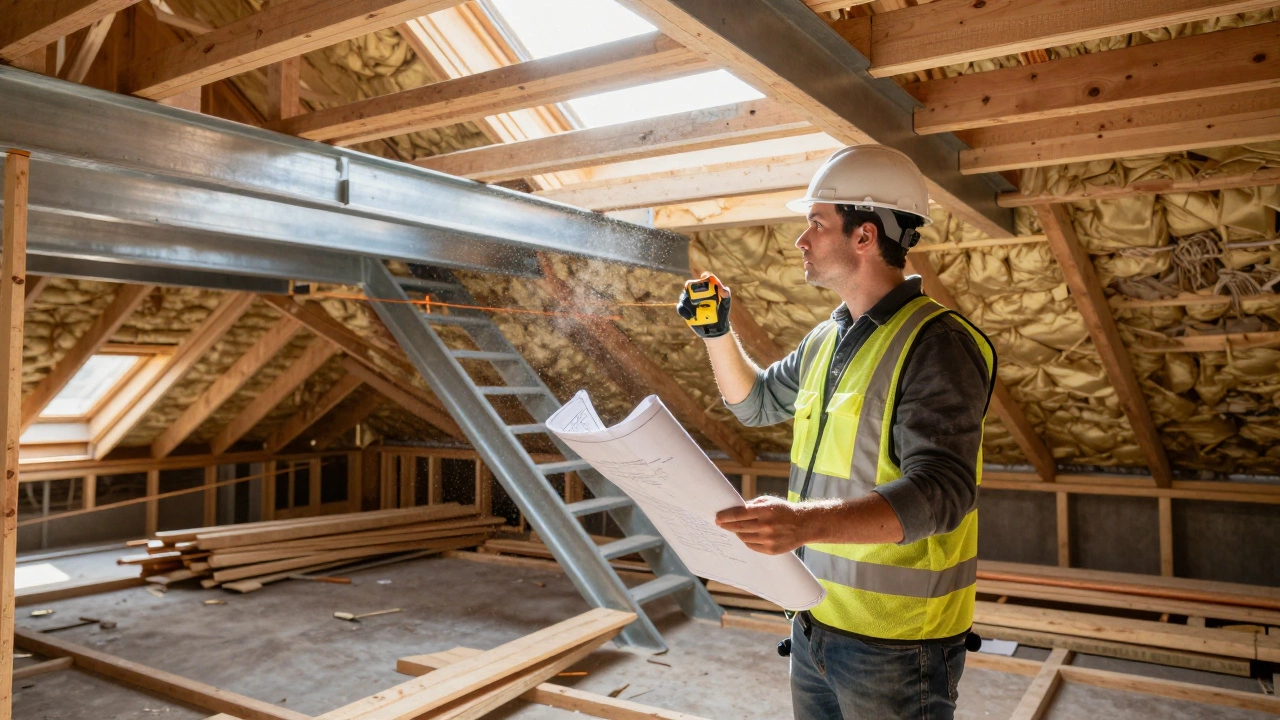
Some people try to cut corners and do it themselves. Bad idea. If you skip proper structural support, your floor could sag. Skip insulation, and your new room will be freezing in winter and sweltering in summer. And if your staircase doesn’t meet the 2025 Building Code requirements (minimum 800mm width, 190mm riser height), you’ll fail inspection-and you’ll have to tear it out.
Here’s the catch: if your loft already has a concrete floor and access stairs, you might save $15,000-$20,000. But most older New Zealand homes have timber floors, low headroom, and no natural light. That’s where the cost climbs.
Do You Even Have a Suitable Loft?
Not every attic is built to be converted. You need at least 2.3m of headroom in the center of the space. If your roof pitch is too shallow-say, under 25 degrees-you might need to raise the roof, which adds $30,000+ to the cost. And if your joists are spaced 600mm apart? They’ll need reinforcing. That’s not a DIY fix.
Check your roof structure. If you have trusses instead of rafters, you’re in trouble. Trusses are engineered as a system. Cutting into them without a structural engineer’s approval can collapse your roof. I’ve seen it happen. A homeowner in Porirua tried to convert his trussed loft in 2023. The ceiling cracked. The insurance company refused to pay. He ended up rebuilding the whole roof.
Also, consider access. If your current stairs are narrow, winding, or made of flimsy timber, you’ll need a new staircase. Building Code says it must be at least 800mm wide, with a maximum 42-degree angle. That means you’ll likely need to sacrifice space on the floor below. Are you okay with losing part of your living room or hallway?
Permits and Rules: Don’t Skip This Step
In New Zealand, all loft conversions require a building consent. You can’t just go ahead and hope for the best. Councils in Wellington, Dunedin, and Christchurch have become stricter since 2024. They now require:
- Energy efficiency reports (compliance with H1 energy performance standards)
- Structural engineering plans signed off by a registered engineer
- Fire safety documentation (including escape routes)
- Drainage plans if adding a bathroom
Processing time? At least 8-12 weeks. Some councils are backlogged. If you’re planning to sell in 12 months, start now. If you wait until you’re ready to move, you’ll be stuck with an unfinished project.
And here’s something most people forget: if your house is in a historic zone (like parts of Thorndon or Lyttelton), you may need resource consent. That’s a whole other layer of paperwork. You can’t just slap on a dormer window if it changes the roofline.
When It’s Not Worth It
Loft conversions aren’t right for everyone. Here are the times you should walk away:
- Your loft is under 15m²-there’s not enough room for a bed, storage, and movement.
- Your roof has asbestos insulation-removal adds $10,000-$20,000.
- You live in a townhouse or apartment with shared roof space-most body corporates ban conversions.
- You plan to move in under 5 years-the return on investment drops sharply if you sell too soon.
- Your budget is under $60,000-you’re better off with a garden shed or a small extension.
One client in Taranaki spent $95,000 on a loft conversion, then sold the house 18 months later. The buyer didn’t care about the extra room-they wanted a flat block of land. The conversion added nothing to the sale price. She lost $40,000.
What Adds Real Value
Not all conversions are equal. The ones that pay off have:
- A proper bathroom (not just a toilet and sink)
- Good natural light (dormer windows or roof lanterns)
- High-quality insulation (R-3.6 or higher)
- A modern, straight staircase (not a spiral or steep ladder)
- Smart storage (built-in wardrobes under eaves)
Adding a bathroom is the biggest value booster. In Wellington, homes with an extra bathroom sell for 10-15% more than those without. And if that bathroom has underfloor heating and a walk-in shower? Even better. Buyers notice details.
Also, don’t forget ventilation. A poorly ventilated loft becomes a mold factory. Install a mechanical heat recovery system (MVHR). It’s not cheap, but it stops damp, odors, and health issues. And yes-it’s required in new builds since 2024.
Alternatives to Consider
Before you commit, ask: is there a cheaper, simpler way to get the space you need?
- Extend sideways: A single-storey addition on the back of your house might cost less than a loft conversion, especially if you have a big backyard.
- Build a granny flat: If your section is over 400m², you can build a separate studio. It’s easier to get consent, and it can be rented out.
- Convert the garage: If it’s detached and in good condition, turning it into a studio is often cheaper and faster.
One family in Hutt Valley did all three options. They got quotes for a loft conversion ($110,000), a garage conversion ($65,000), and a backyard studio ($75,000). They chose the garage. It took 8 weeks. No structural changes. No council delays. They used it as a home office and rented it out for $450/week. They broke even in 18 months.
Final Verdict: Yes, But Only If...
Is it worth converting your loft? Yes-if:
- You have enough headroom and structural space
- You’re staying in the house for at least 5 years
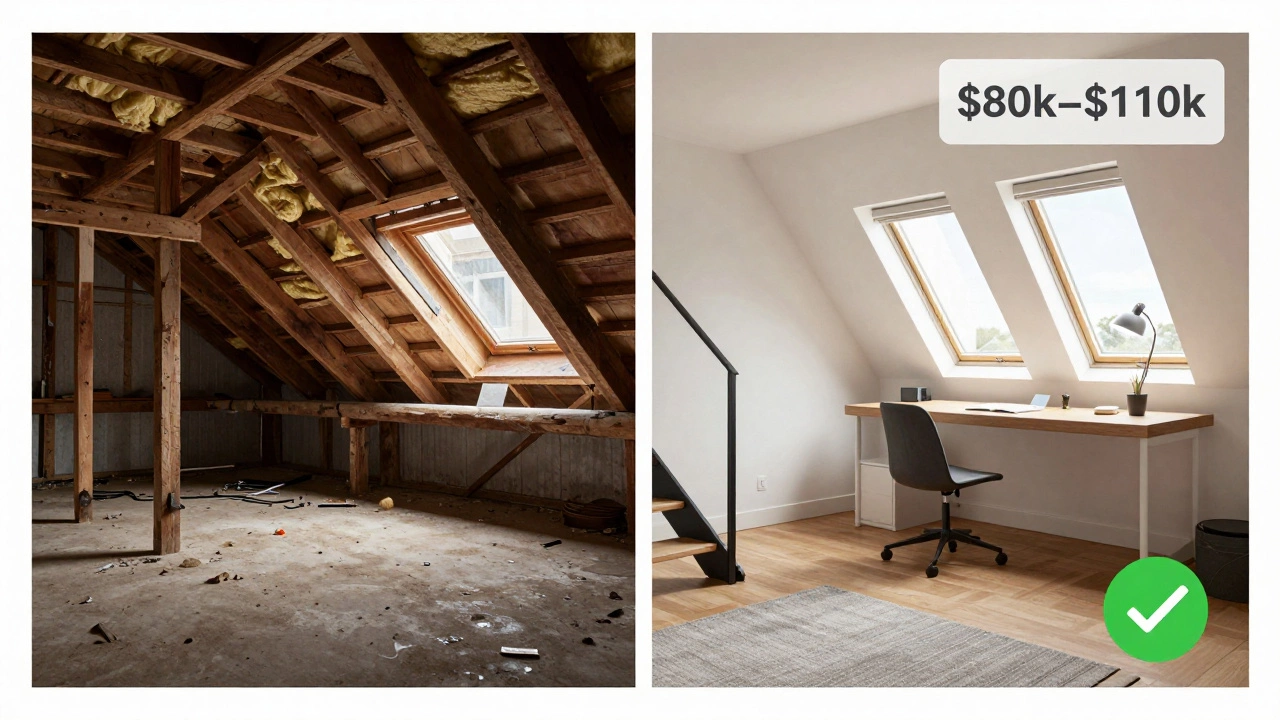
- You’re willing to spend $80,000-$110,000
- You want a bedroom or bathroom you can’t get any other way
- You’ve checked with your local council and got pre-approval
If any of those boxes are unchecked, walk away. Don’t rush. Don’t listen to the guy at the hardware store who says, “It’s easy.” It’s not. And if you mess it up, you’ll be stuck with a room that’s unusable, illegal, or dangerous.
Do your homework. Get three quotes. Talk to a structural engineer. Visit a completed conversion in your neighborhood. Ask the owners what they wish they’d done differently. Then decide.
How long does a loft conversion take in New Zealand?
A typical loft conversion takes 8 to 14 weeks from start to finish. That includes 2-4 weeks for council consent, 4-8 weeks for construction, and 1-2 weeks for final inspections. If you’re adding a bathroom or changing the roofline, add another 2-3 weeks. Weather in Wellington can also delay work, especially if you’re installing roof windows during winter.
Can I live in my house while the loft is being converted?
Yes, most people do. But it’s messy. Dust will get into every room. You’ll lose access to the stairs for 3-5 days while the new staircase is installed. Noise from drilling and cutting happens daily. If you work from home, have a backup plan. Some families rent a short-term apartment for the duration. Others move into the garage or a tent in the backyard.
Does a loft conversion need a bathroom?
No, it doesn’t legally require one. But if you’re adding a bedroom, the New Zealand Building Code expects a nearby bathroom. Most buyers won’t pay a premium for a bedroom without a bathroom nearby. So while it’s not mandatory, it’s practically essential for value and usability.
How much value does a loft conversion add to a house in Wellington?
On average, a well-executed loft conversion adds 20% to 30% to your home’s value. That’s based on recent sales data from the Real Estate Institute of New Zealand. For example, a $900,000 home with a $95,000 conversion sold for $1.18 million-$180,000 more than similar homes without conversions. But only if the work is high quality and fully permitted.
What’s the most common mistake people make with loft conversions?
Underestimating the structural work. Most people think it’s just about adding walls and a floor. But in older homes, the floor joists are too weak, the roof rafters are rotten, and the insulation is non-existent. Skipping proper engineering leads to sagging floors, cracking ceilings, and failed inspections. Always get a structural engineer’s report before you sign a contract.