
What is the 345 Rule in Construction? A Guide to Squaring Foundations
 May, 24 2026
Interactive 3-4-5 Foundation Squaring Simulator
Adjust Layout Measurements
Formula: √(A² + B²)
Your foundation corner is a perfect 90 degrees.
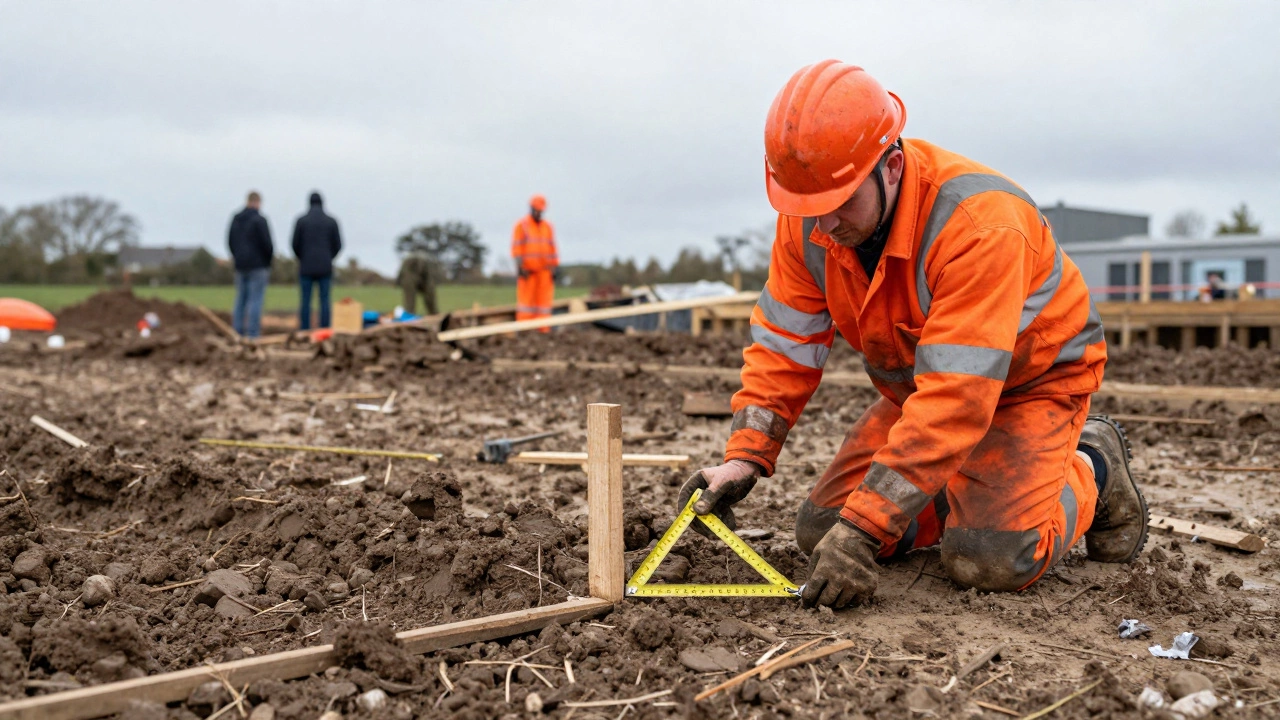
Imagine you are standing on a muddy job site with a crew waiting for your signal. You need to lay out the corners of a new warehouse foundation. If those corners aren't perfect right angles, every wall will be slightly off. Over fifty feet, that small error turns into a massive gap where the roof won't fit. You don't have a laser level handy, or maybe the battery died. What do you do? You reach for your tape measure and use the 345 rule.
This isn't just a trick for beginners; it is a fundamental method used by builders worldwide to ensure structures are square. It relies on basic geometry rather than expensive technology. Understanding this method saves time, prevents costly rework, and ensures your building complies with structural standards.
The Math Behind the Magic
The 345 rule is a practical application of the Pythagorean theorem, a mathematical principle discovered over 2,500 years ago. The theorem states that in a right-angled triangle, the square of the hypotenuse (the longest side) equals the sum of the squares of the other two sides. In formula terms: a² + b² = c².
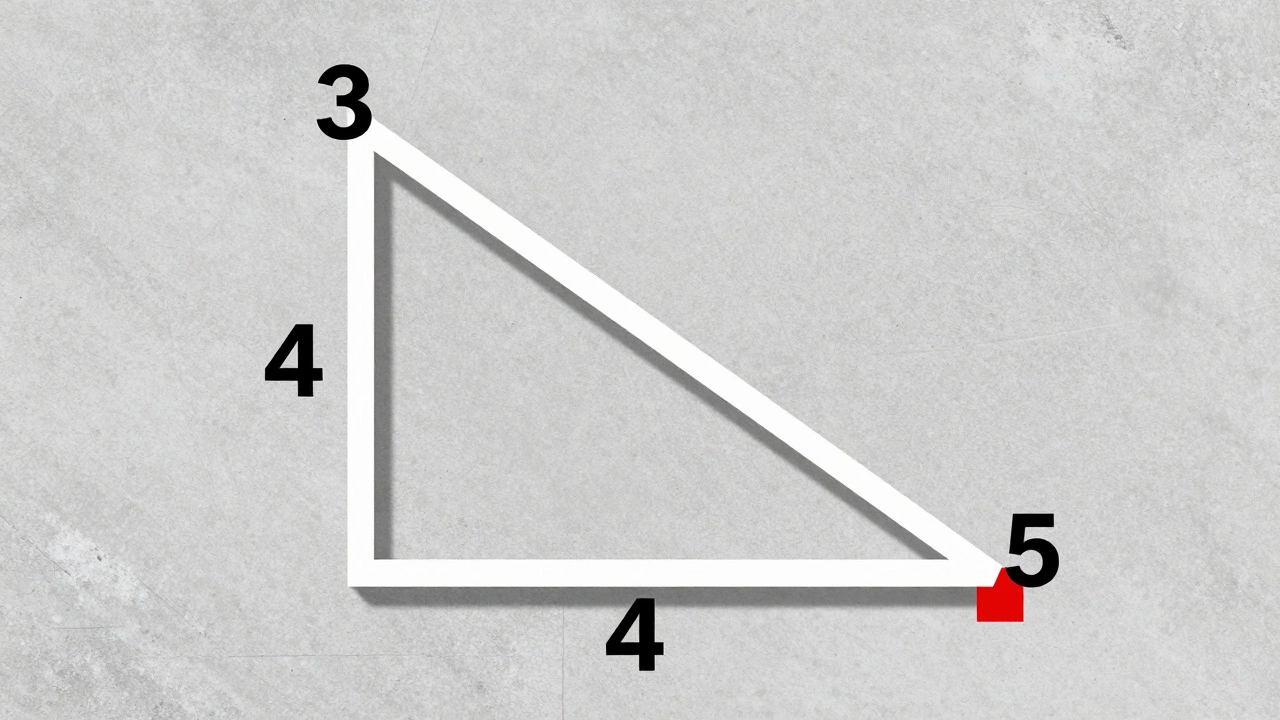
In construction, we simplify this by using whole numbers that fit the equation perfectly. If one side is 3 units long and the adjacent side is 4 units long, the diagonal connecting them must be exactly 5 units long. This creates a perfect 90-degree angle. This specific combination of 3, 4, and 5 is known as a Pythagorean triple.
You might wonder why not use 1, 1, and 1.414? Because measuring 1.414 inches or millimeters is difficult with standard tools. The 3-4-5 ratio uses clean integers. Whether you are working in feet, meters, or yards, the proportion remains the same. This simplicity makes it ideal for rough layouts before fine-tuning with more precise instruments.
How to Apply the 345 Rule on Site
Using the rule requires a bit of preparation but very little effort during execution. Here is how professionals apply it to square a foundation or a room.
- Mark Your Corner: Start at one corner of your layout. Drive a stake or make a clear mark on the ground or subfloor.
- Measure Side A: Along one edge, measure out 3 feet (or 3 meters). Make a mark. This is your first leg of the triangle.
- Measure Side B: From the same corner, along the perpendicular edge, measure out 4 feet (or 4 meters). Make a second mark. This is your second leg.
- Check the Diagonal: Measure the distance between the end of the 3-foot mark and the end of the 4-foot mark. This is the hypotenuse.
- Adjust Until Perfect: If the diagonal measures exactly 5 feet, you have a perfect 90-degree angle. If it is longer, the angle is less than 90 degrees (acute). If it is shorter, the angle is greater than 90 degrees (obtuse). Adjust the position of the 4-foot line until the diagonal reads exactly 5.
Once that first corner is squared, you can repeat the process for the remaining corners. Alternatively, once you have two adjacent sides square, you can measure the diagonals of the entire rectangle. If both diagonals are equal length, the structure is square.
Scaling Up for Large Projects
On a small shed, a 3-4-5 triangle works fine. But what if you are laying out a commercial parking lot or a large office building? Measuring only 3 feet leaves too much room for error relative to the total size. A tiny shift in the stake position causes a significant deviation over long distances.
To maintain accuracy on larger jobs, scale up the numbers while keeping the ratio intact. Multiply each number by ten. Instead of 3-4-5, use 30-40-50. For even larger sites, multiply by a hundred: 300-400-500. The larger the triangle, the more precise your angle becomes because minor measurement errors become negligible.
| Project Size | Side A (Units) | Side B (Units) | Diagonal C (Units) | Best Use Case |
|---|---|---|---|---|
| Small (Sheds, Decks) | 3 | 4 | 5 | Quick checks, tight spaces |
| Medium (Residential Homes) | 30 | 40 | 50 | Foundation footings, framing walls |
| Large (Commercial Buildings) | 300 | 400 | 500 | Site grading, large slabs, roadways |
Common Mistakes to Avoid
Even experienced contractors make errors when rushing through layout work. Here are the most frequent pitfalls.
- Mixing Units: Never mix feet and meters unless you convert precisely. A 3-meter side does not equal a 3-foot side. Stick to one system throughout the layout.
- Sagging Tapes: When measuring long diagonals, ensure the tape measure is held taut and at a consistent height. Sagging tapes give false readings, making the diagonal appear longer than it is.
- Ignoring Ground Slope: If the ground is uneven, horizontal measurements differ from sloped measurements. Always measure horizontally if possible, or account for the slope in your calculations.
- Stake Placement: Ensure your stakes are driven vertically. A leaning stake changes the effective point of measurement, introducing angular errors.
When to Use Technology Instead
While the 345 rule is reliable, modern construction often demands higher precision. Laser levels and total stations offer millimeter-level accuracy. However, these tools require calibration, batteries, and skilled operators. They also fail in bright sunlight or heavy fog.
The 345 rule serves as an excellent backup. Many surveyors use electronic equipment for the initial rough layout and then verify critical corners with the 345 rule. This redundancy catches equipment errors. Additionally, for interior finishing work like tile installation or drywall framing, the physical nature of the 345 rule is faster than setting up a laser grid.
Why This Matters for Commercial Projects
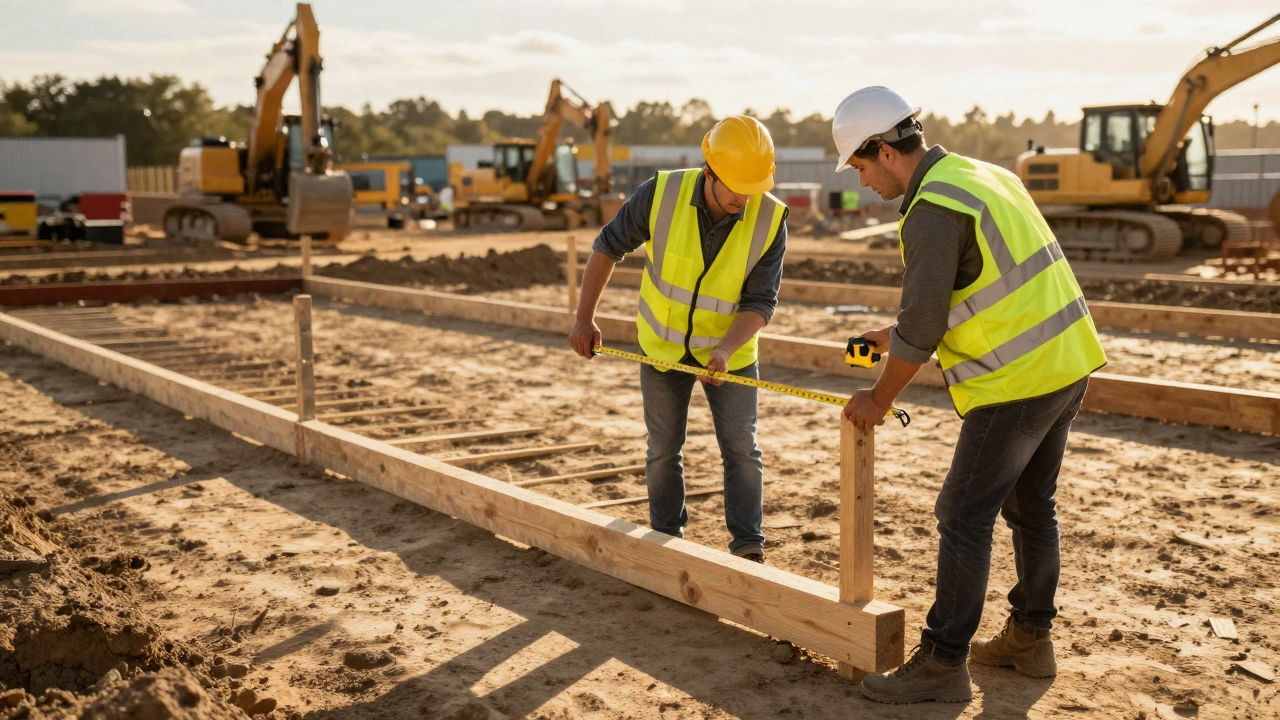
In commercial construction, tolerances are strict. Building codes often specify maximum deviations for plumb and square. A foundation that is out of square can lead to misaligned columns, uneven floor loads, and doors that don't close. These issues result in change orders, delays, and potential liability claims.
Using the 345 rule demonstrates due diligence. It shows inspectors and clients that you verified the geometry manually. It builds trust. Moreover, it empowers junior team members to contribute to quality control without needing expensive certifications or tools.
Related Concepts in Layout Geometry
Understanding the 345 rule opens the door to other geometric principles used in construction. The concept of "batter boards" relies on creating stable reference points outside the excavation area. String lines stretched between batter boards define the exact edges of the foundation. The 345 rule ensures these strings meet at true right angles.
Another related concept is the diagonal check. For any rectangle, the diagonals must be equal. If you have a rectangular layout, measuring both diagonals provides a quick verification. If they match, the shape is square. This method complements the 345 rule by checking the overall integrity of the layout rather than just individual corners.
Can I use the 345 rule for metric measurements?
Yes, absolutely. The 345 rule is based on ratios, not specific units. You can use 3 meters, 4 meters, and 5 meters. Or 30 centimeters, 40 centimeters, and 50 centimeters. Just ensure all three measurements use the same unit type.
Is the 345 rule accurate enough for high-rise buildings?
For initial rough layouts, yes, especially when scaled up significantly (e.g., 300-400-500). However, final positioning of steel columns and core walls usually requires total stations or robotic lasers for millimeter precision. The 345 rule is best used for verification and smaller-scale elements.
What if my diagonal doesn't measure exactly 5?
If the diagonal is longer than 5, your angle is too narrow (less than 90 degrees). Move the outer end of the 4-unit line outward. If the diagonal is shorter than 5, your angle is too wide (more than 90 degrees). Move the outer end of the 4-unit line inward. Adjust until it hits exactly 5.
Do I need a helper to use the 345 rule?
It is much easier with a helper. One person holds the tape at the corner, another marks the 3 and 4 units, and a third measures the diagonal. Working alone is possible but slower and prone to parallax errors where your eye view distorts the measurement.
Can I use other numbers besides 3, 4, and 5?
Yes, any Pythagorean triple works. Common ones include 5-12-13, 8-15-17, and 7-24-25. These are useful if you need a different aspect ratio for your layout. However, 3-4-5 is the easiest to remember and calculate mentally.